Securing high level partner and patient engagement through non-invasive drug delivery innovation
R&D is the cornerstone of any company striving to maintain a market leadership position, with much of the work focussed on continuous improvement; teams working on advancing products and processes in close collaboration with customers.
It is only in true market leader organisations that pure innovation is encouraged, with experts devoting time to genuine research alongside their operational responsibilities.
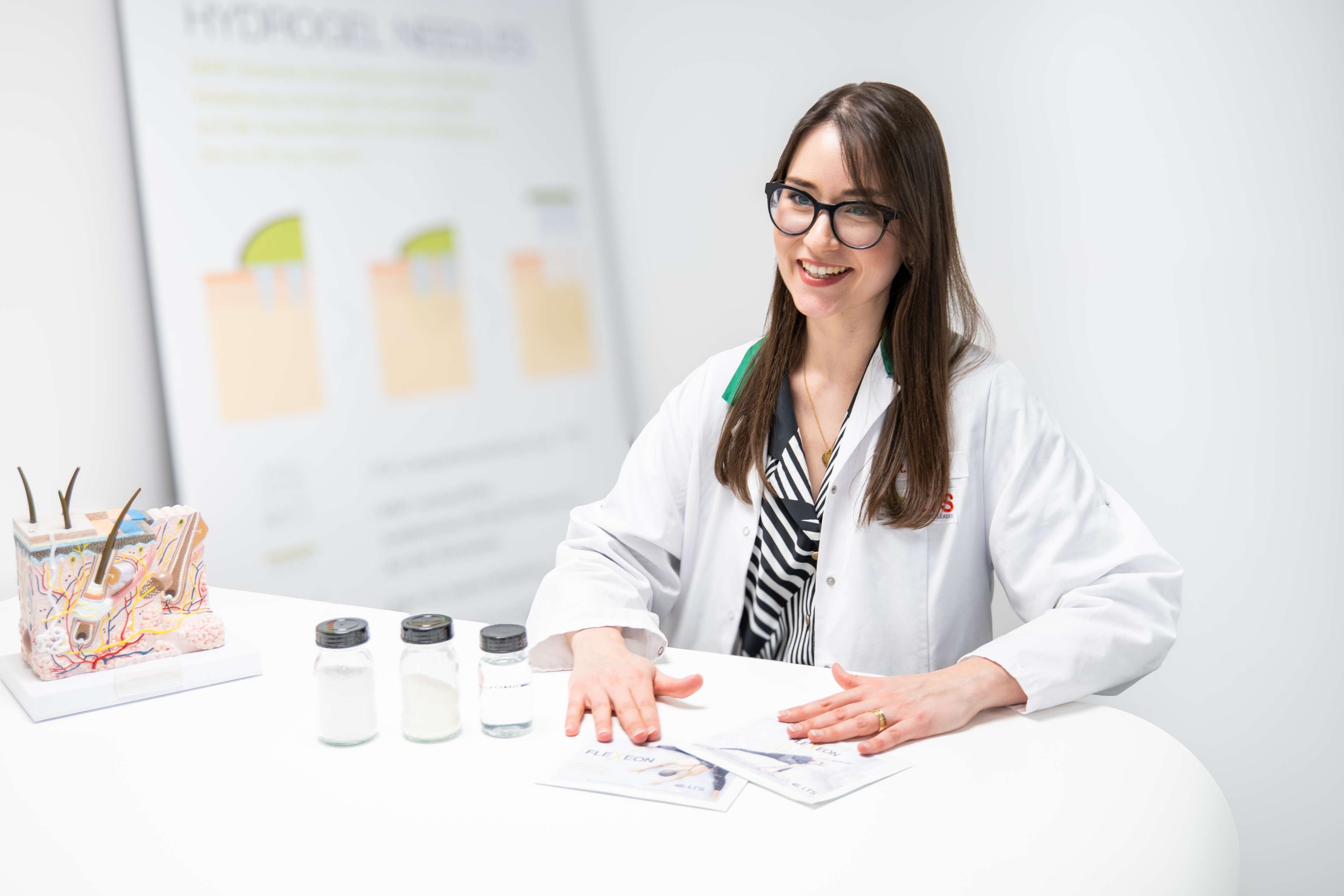
One such example is Regina Graf, who is pursuing her doctoral studies while working at LTS. In cooperation with the OWL University of Applied Sciences and Arts, the Institute for Life Science Technologies (ILT.NRW), and the Institute for Industrial Information Technology (inIT), her doctorate research explores data‑driven design of experiments (DoE) concepts for the development of hot‑melt extrusion processes. The collaborations she has established not only create room for fundamental, future facing research, but also provide valuable insights into other disciplines. Working closely with academic partners from different fields enables truly interdisciplinary teams to emerge, combining industrial experience with methodological and technological expertise from academia to foster new perspectives that reach beyond immediate project demands.
Here is the new perspective she has reached…
Employed to great effect outside of the pharmaceutical industry for decades, hot-melt extrusion (HME) is now becoming established as an increasingly important tool in the armoury of modern drug manufacturers.
In recent years it has attracted growing support as an innovative means of production, particularly for poorly soluble molecules, by facilitating even drug distribution and promoting bioavailability while avoiding the use of solvents. Applications for HME are broad, including in the manufacture of transdermal therapeutic systems (TTS) pioneered by LTS.
While rooted in the same approach the HME manufacturing process will vary for each active pharmaceutical ingredient. Typically, a Design of Experiments (DoE) model will be followed to explore the proposed method. However, many modern methods of design have shortcomings, whether in terms of the strength of the insights they elicit, their potential to be adapted, or both, which can present challenges for the development of complex processes such as HME.
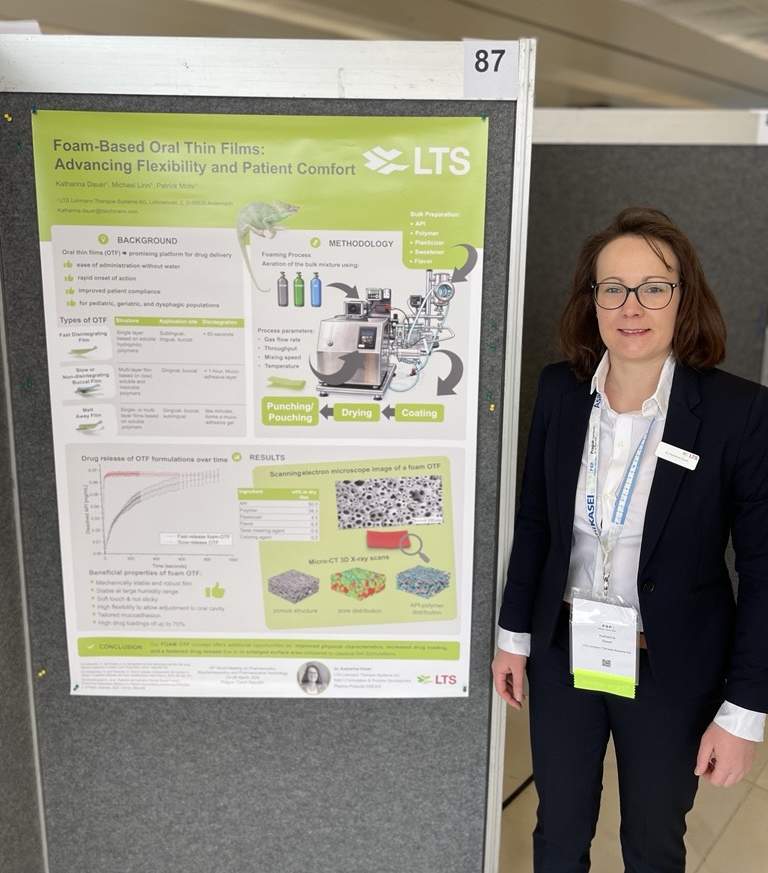
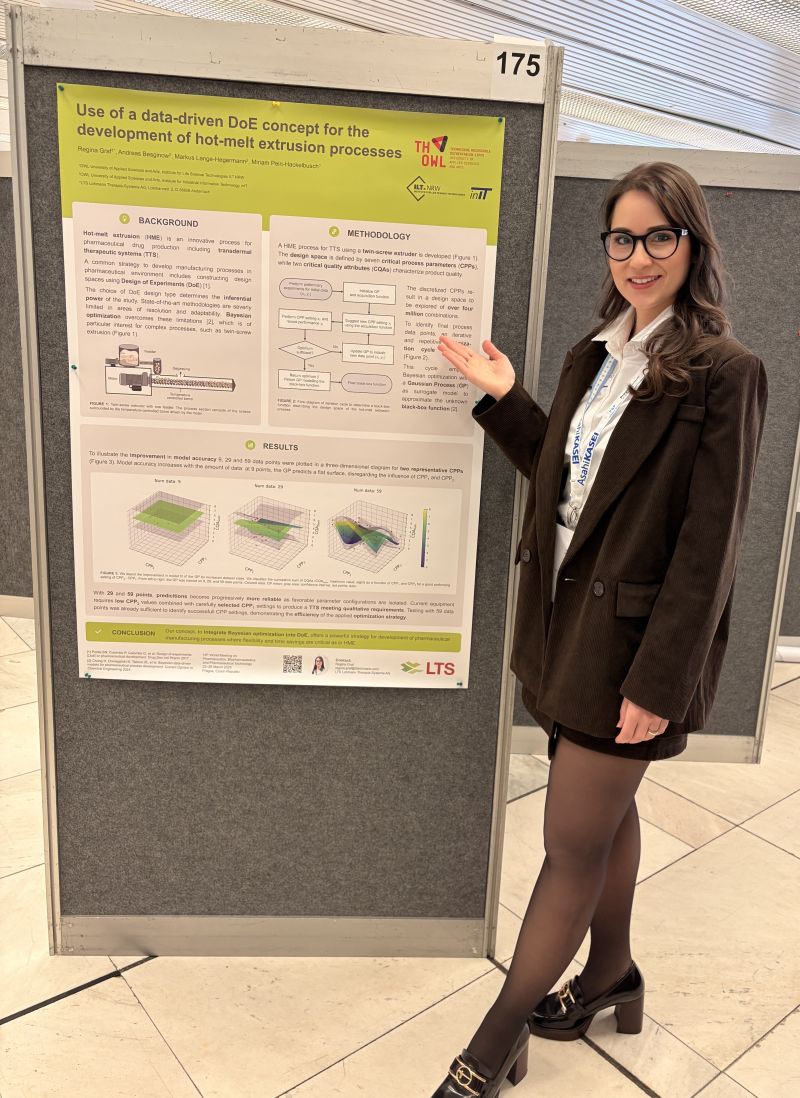
In this context, Bayesian optimisation presents a promising solution for overcoming these limitations. At the 15th World Meeting on Pharmaceutics, Biopharmaceutics and Pharmaceutical Technology (PBP World Meeting) in Prague, March 2026, Regina Graf, Scientist, Pharmaceutical Research & Development at LTS, presented a major aspect of her dissertation as a poster explaining how this approach can help manufacturers move beyond the limits of classical DoE methods to enhance process development for HME.
The poster details a HME process for TTS using a twin-screw extruder. With seven critical process parameters (CPPs) and two critical quality attributes characterising product quality, the design space to be explored features over four million combinations.
Bayesian optimisation was employed with a Gaussian Process as a surrogate model to approximate the design space parameters, with an iterative and repetitive optimisation cycle then implemented to enable the final function to be determined.
The results highlighted an improvement in model accuracy in line with an increase in the size of the dataset used. Predictions became progressively more reliable, and testing with 59 data points was deemed sufficient to identify successful CPP settings. For a process as complex as HME, this underlines the power of integrating Bayesian optimisation into a DoE approach, and its potential to introduce significant flexibility and time savings for this crucial stage of the drug product manufacturing process.